

A slow loading website makes visitors leave, which means fewer calls, fewer form submissions, and fewer sales. Even a one second delay on mobile can spike bounce rates, while faster load times tend to lift conversions and search visibility. For small businesses, that shows up as quiet phones and lost revenue.
That’s the part most owners miss. Speed sounds like a technical detail, but it behaves like a leak in a bucket. You can pour more money into ads, post more on social media and work on SEO, and customers keep slipping out the side. The worst part is that it’s quiet. No alarm tells you, “You just lost three leads in the last hour because the page took 6 seconds to load.”
When Slow Sites Quietly Drive Customers Away
Let’s make this clearer with an everyday analogy. Imagine you run a shop in town and a new customer walks up to the door. They pull the handle, but the door sticks. They pull again. Still stuck. After 5 or 6 seconds, they shrug and move on to the next store where the door opens right away. That’s what a slow website feels like on a phone.
Research on user behavior has been consistent for years. Slow pages create a bad experience, and bad experiences lead to abandonment. People will wait in a long restaurant line on a Saturday night, but online the back button is instant and your competitor is one tap away.
So when I talk about a slow loading website for a small business, I mean real customers who were interested enough to click, then left before they saw your offer, your reviews, your photos or your phone number. That is money quietly leaking away.
The Real Numbers Behind Slow Pages and Lost Sales
Numbers help us understand what our gut already knows. Google’s research has shown that as mobile page load time increases, the probability of a bounce rises sharply. Moving from 1 second to 3 seconds can increase the chance a visitor leaves by 32%. Push it to 5 seconds and it jumps to 90%. That’s the difference between “most people stick around” and “most people disappear.”
On the conversion side, I like using a stat that sticks in your head. A one second improvement can boost conversions by 27%. Think about that. If your site currently gets 100 visitors a week from search and referrals, and 10 of them call or fill out a form, a meaningful speed improvement could move that number closer to 13 without buying a single extra click. Same traffic, more leads.
Big retailers feel this too. Industry reports have estimated that retailers lose billions each year to slow websites. It’s easy to hear “billions” and think, “That’s Amazon’s problem.” Small businesses feel the same pain in a different form: fewer quote requests, fewer appointment bookings, fewer taps on the call button, and that uncomfortable moment when you realize the phone has been quiet all afternoon.
If you are spending $1,000 a month on marketing and your site is slow, it’s like paying for a newspaper ad that sends people to a store with the lights off. You might still get a few determined customers, but you are paying to lose the rest.
Unsure if your site passes the test? Contact me at (541) 226 8087 for a free performance review.
The Black Bird Loaded in Less Than Half the Time
The Black Bird’s website carries a hardware store’s worth of departments, weekly sales and event pages. When we tuned its pages for speed, page weight dropped by more than two thirds and the main content appeared on a phone in less than half the time.
Before-and-after lab runs recorded in the September 10, 2026 work log. Page weight fell from 1,715 KB to 528 KB. Laboratory scores can change from one test to the next.
Same store, faster front door
Shoppers now see the weekly sales circular and the departments they came for in about three and a half seconds on a phone.
See The Black Bird project →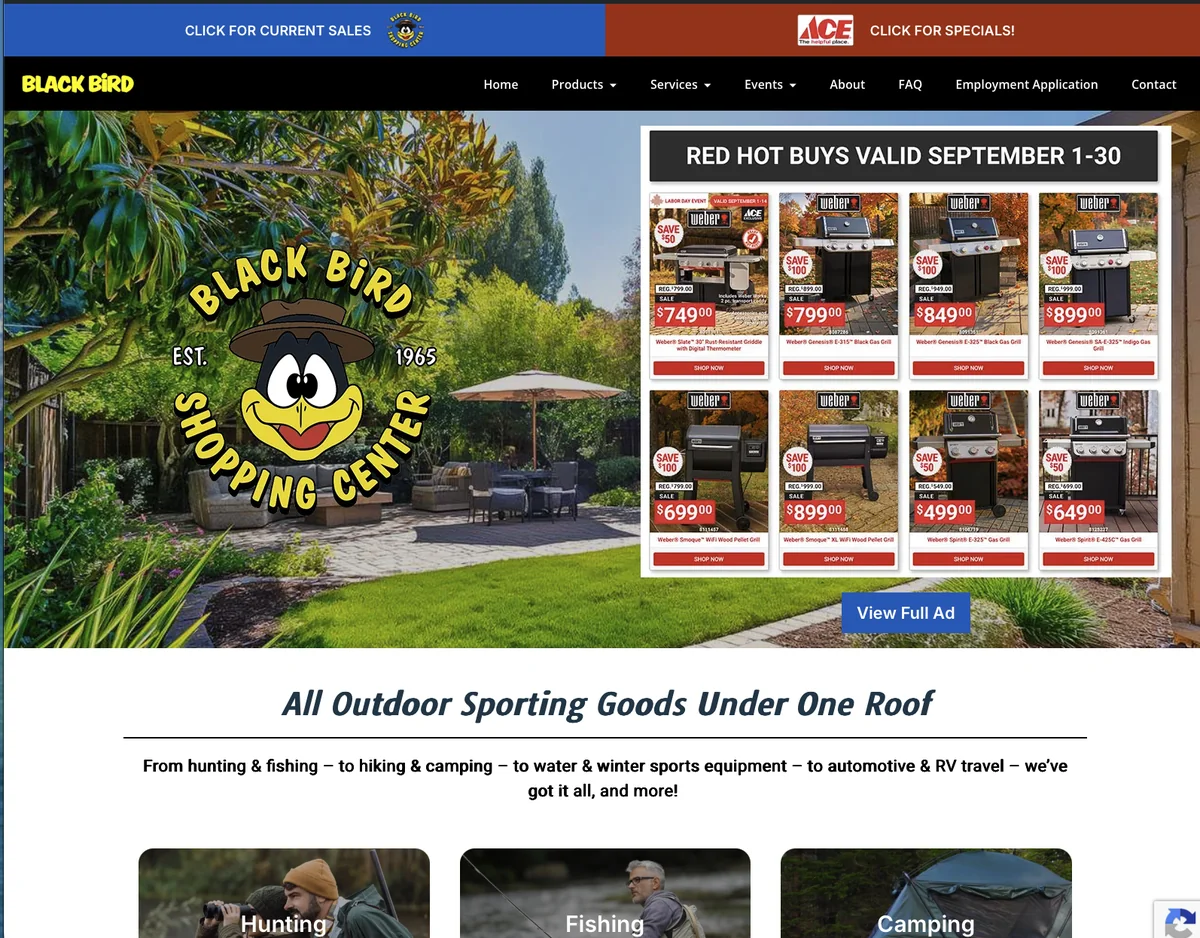
What’s Actually Slowing Down Your Website
When owners ask me, “Why is my site slow?” they usually expect a complicated answer. The most common causes are practical, and you can understand them without reading a single line of code.
Oversized images are a big one. I regularly see homepages loading 4MB, 6MB, even 10MB of images because someone uploaded photos straight from a phone. That’s like trying to mail a hardcover book when a postcard would do. On mobile data, those extra megabytes cost time.
Then there are bloated themes and page builders. Many templates come packed with sliders, animation libraries, extra font files and features you never asked for. It’s like buying a delivery van that comes with a built-in karaoke machine, a fog machine and a popcorn maker. Fun, maybe, and every one of them slows the deliveries down.
Finally, there are unnecessary scripts, things like too many tracking tags, chat widgets, pop-up tools, and third-party plugins. Each one may seem small, but together they can turn your site into a busy phone exchange where every caller is put on hold while the operator connects five other lines first.
Want to check your site right now? Here’s a quick walkthrough using free tools:
1) Go to Google PageSpeed Insights and paste in your homepage URL. Pay attention to the “Mobile” score, the load time metrics, and any warnings about images or scripts.
2) Run the same test on a key service page as well as the homepage. If your “Roof Repair” page is slow, that’s where leads are getting lost.
3) Look for red flags like “Largest Contentful Paint” taking several seconds, or repeated notes about “render-blocking resources.” You don’t need to memorize the terms. Look for the pattern, because the tool is telling you what’s weighing the site down.
If you want, I’ll do a complimentary high-level speed review as part of an introductory call. I’ll look at your site on a phone, run the tests, and tell you in plain English what’s slowing it down and what to fix first.
Site Speed’s Direct Impact on Google Rankings
Speed also affects whether you get found. Google has made it clear that performance matters. It measures real-world experience through Core Web Vitals, and while content and relevance still count most, a slow, clunky site is fighting uphill.
Most small business traffic is mobile. If your site performs poorly on a phone, Google sees it and customers feel it. Slow sites rarely get a dramatic penalty. They slide down the page while faster competitors rise.
Industry studies show that a meaningful share of small business sites still fall short of mobile-friendly standards. I see it firsthand: text that’s too small, buttons too close together, layouts that break on certain phones, and pages that load like it’s 2009. If your site is in that group, you have plenty of company, and a real opportunity to get ahead of it.
That’s why Good Creations sites are designed mobile first. We build for the phone screen before the desktop, so the site feels natural on a phone, loads fast, and makes it easy to tap and call.
If you want more context on the design side, this connects closely with mobile first web design for small businesses, because speed and mobile usability are tied together.
Turning Faster Load Times Into More Leads
I like to remind owners that traffic is only the start. Traffic is people walking past your storefront. Leads are people walking in, asking questions and buying. Speed turns passersby into customers because it removes the friction at the door.
Now combine speed with strong calls-to-action. This is where results start compounding. Let’s say a local HVAC business gets 1,000 visits a month, and 2% of visitors call, that’s 20 calls. If the site is slow and confusing on mobile, that 2% might be optimistic. But if we shave a couple seconds off load time, clean up the layout, and add a clear “Tap to Call” button that stays visible, that conversion rate can move.
Imagine going from 2% to 3%. That’s 30 calls from the same 1,000 visits. Ten extra calls a month doesn’t sound flashy until you remember what one booked job is worth. If an average job is $500, and you close even 30% of those extra calls, that’s $1,500 more revenue per month. That’s real-world money created by removing a few seconds of waiting and making the next step obvious.
Heavy animations and flashy features are often a bad trade. They may look impressive for 9 seconds in a demo, and then they slow the site down and pull attention away from the action you want: calling, booking or requesting a quote. Good Creations builds for performance first, with clean layouts and a clear next step on every page.
Real Site Speed Takes More Than Hosting
Let’s clear up two misconceptions I hear all the time.
First, “I’ll just upgrade hosting.” Better hosting can help, but hosting is only one part of the equation. If your site is dragging around huge images, loading five font families, and running a pile of scripts, faster hosting is like putting premium fuel in a truck that’s overloaded. It might feel a little better, but the real issue is the weight.
Second, “DIY templates are always fast.” Some are, and the bigger question is what happens after the template is installed. Owners add plugins, embed third-party widgets, stack on tracking tools and upload uncompressed images. The site starts out quick, then slowly turns into a junk drawer. We have all seen it happen, one extra “helpful” tool at a time.
Real performance comes from thoughtful design, clean builds and regular testing. It’s choosing what to leave out, building pages that do their job with nothing extra, and checking speed after every change.
Performance work is part of our website builds. We explain the work and cost in your quote. If your current website is slow, we can help you decide whether updating it or rebuilding it makes more sense.
What Fast Looks Like on a Phone
These are Google PageSpeed Insights results for two websites we built. Russco Enterprises is an excavation company in Douglas County. Oregon RV Outlet is an RV dealership in Grants Pass with a photo-heavy inventory.
Russco Enterprises · Mobile
Google PageSpeed Insights, August 2, 2026
Oregon RV Outlet · Mobile
Google PageSpeed Insights, September 11, 2026
Individual homepage laboratory tests; scores can change between runs. Both sites scored 100 for desktop performance. See the Russco project · See the Oregon RV Outlet project
You Can Leave the Tech to Us
If all of this feels like a lot, I get it. You went into business to serve your customers, and your time belongs with them, your staff and your work.
You can have a fast site without becoming a performance expert. What you need is a partner who builds speed into the foundation.
Good Creations includes lifetime support and training. If you add a new page and it feels sluggish, you can ask. If you upload new photos and things slow down, you can ask. If Google changes what it cares about, you can ask. Performance is ongoing, and having someone to call works like insurance: you hope you never need it, and you’re glad it’s there when something changes.
Think of it this way: a fast site protects the marketing you already pay for. It protects your reputation when a customer is in a hurry, and it protects your lead flow when competitors are trying to outrank you.
Make Speed Standard
A slow website costs you leads because people abandon the page. It hurts search visibility because Google pays attention to performance and mobile experience. And it makes a business feel outdated, even when the service is excellent.
If your site takes several seconds to load on a phone, that’s a fixable problem, and fixing it is one of the most direct investments you can make in more calls, more forms and more booked work.
If you’re ready for a site that makes speed, mobile usability and a clear next step standard from day one, call me at (541) 226-8087, and I’ll start with a quick review of what’s slowing your site down and what it would take to rebuild it.
Related Articles

I run Good Creations in Grants Pass. I work directly with business owners on website design, content, and search. My work includes service writing, inventory websites, and custom publishing tools.
Meet Bob