Question: How do I design a local business website?
Answer: Show your location and service area clearly, build for phones first with tap-to-call buttons, add reviews from local customers, and give visitors a simple way to get in touch. Write your pages around the words local people search for, and make it easy to call or request a quote from every page.
What Makes a Local Website Different
Most web design advice is written for online stores and tech startups selling to the whole world. If you run a plumbing company, a dental practice or a local law firm, your website has a different job.
Your visitors are local. They are usually on their phones, often in a hurry, and they want to know one thing: “Can you help me right now, here in this town?”
A local business website earns its keep when the phone rings. Here is what your site needs to turn local visitors into calls.
1. Location, Location, Location
For a local business, your location is your headline. Your customers and search engines both need to know exactly where you work.
Put your city names, neighborhoods and service area on your homepage and in your footer, as well as on the contact page. If you serve the greater Medford area, say so in those words.
Good Creations writes your page content and search titles so those local details stand out. We make sure Google sees you as a “Medford roofer,” which helps you show up when people nearby search for help.
2. Mobile-First Means “Call-First”
Local searches happen on phones. Someone’s pipe just burst, or they are locked out of their car. They are standing in the kitchen or on the sidewalk, and they need you now.
Your design should match that urgency.
- A call button that stays put. We place a “Call Now” button at the bottom of the phone screen, so it is always one tap away.
- Tap-to-call numbers. Every phone number on the site dials when someone taps it.
- Short forms. If they prefer to write, the form is short and easy to fill out with a thumb.
Slow pages and awkward phone layouts send visitors back to the search results. We build every site to load fast on mobile networks, because on a local website speed means leads.
Want to see what a mobile-first local site looks like? Call me at (541) 226-8087 and I’ll show you examples of sites that make calling easy.
3. Trust Is Local
A stranger in your town needs a reason to choose you. The most convincing reason is a neighbor who already did.
Local trust is built with specifics. For example: “Bob and his team fixed our AC in record time during the July heatwave here in Hyde Park.” (Sarah M., Chicago)
We encourage clients to use real first names and neighborhoods in their reviews, with permission. When visitors see their own neighborhood mentioned, they feel at home. We place those reviews on the pages where people make their decision, beside the services they describe.
4. Speak the Local Language
Your content should sound the way local people talk. Do they search for “automotive repair” or “car shop in Grants Pass”?
We create pages that answer specific local questions:
- FAQ pages that answer common questions like “Do you service the North Side?”
- Service area pages for the specific towns or counties you cover.
- Local wording, with phrases like “near me” and your city names used naturally in the text.
Our standard website includes 5 to 7 pages written around these real searches, so the visitors you attract are the ones ready to hire you.
5. Make the Next Step Easy
Whether the next step is calling, requesting a quote or booking a visit, it should be obvious from every page.
For local lead generation, keep forms simple: name, phone and “How can we help?” Tell people when to expect an answer, such as “We reply within 1 hour.”
Every form we build sends you an instant notification, so every inquiry reaches you. You can focus on your work knowing your website is catching every lead.
6. Measuring What Matters
How do you know it is working? For a local business, calls and form submissions are the numbers that count.
We set up analytics as part of every build. You can see how many people tapped “Call Now” and how many filled out your form, so your website becomes a business asset you can measure.
Turn Your Site Into a Local Lead Generator
An effective local business website combines a clear location, fast mobile pages and local trust, and it turns all three into phone calls.
If your site isn’t bringing in calls, a redesign built around your local customers is the next step.
Call (541) 226-8087 to talk about your website.
Keep the inquiry connected to the item
On the Oregon RV Outlet website, call, text, and inquiry options appear alongside inventory. Someone looking at an RV can ask about that vehicle while its details are in front of them.
For a service business, the equivalent might be a contact link beside the relevant service or project. The useful check is whether the visitor can move from their question to the right conversation. The presence of a button alone does not prove that more people called or became customers.
Pacific Charter Sends Visitors Straight to Booking
Pacific Charter Services runs fishing trips on the Oregon Coast. Every trip page leads to an online catalog where guests pick a date and book.
Google Analytics, August 20 to September 16, 2026, all traffic sources. Booking-page views count visits to the booking page, not completed reservations.
From reading to booking
A guest reading about halibut season is one click from choosing a date on the charter they want.
See the Pacific Charter project →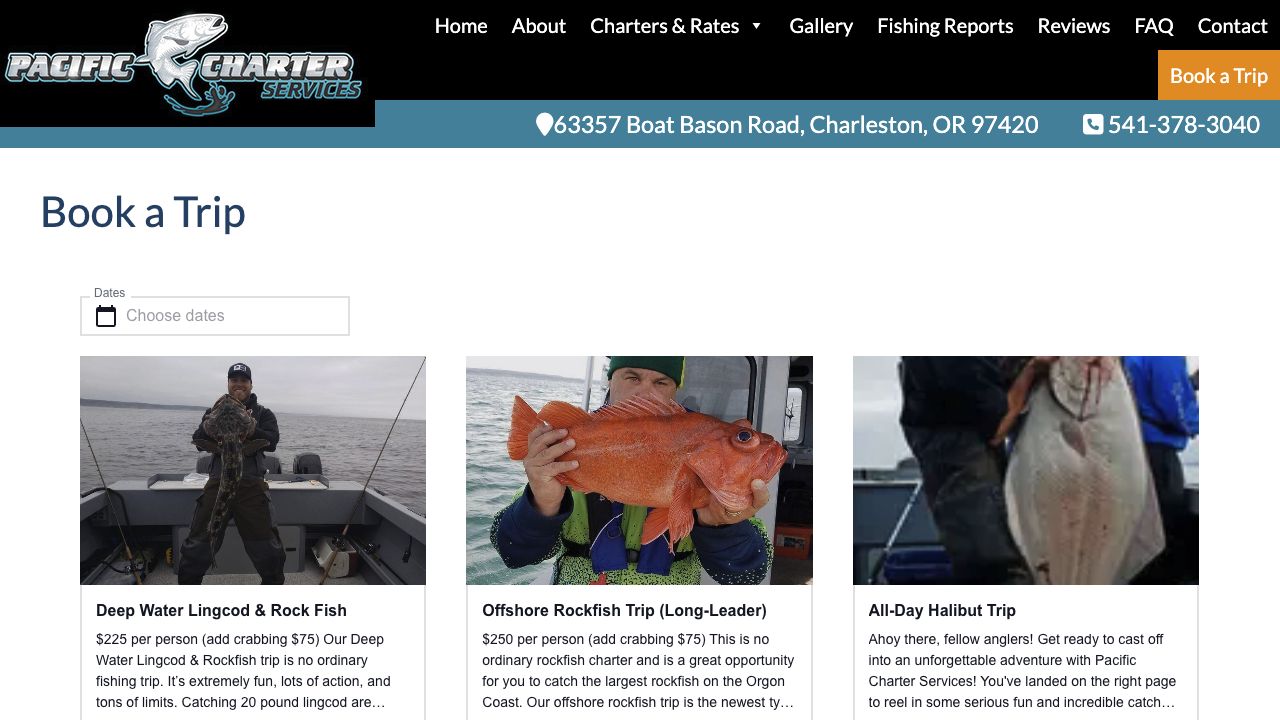
Oregon RV Outlet Turned Its Inventory Into Search Traffic
Every RV on Oregon RV Outlet’s lot has its own page with photos, specifications and a way to call or text about that unit. Those pages give Google something specific to show for each search a shopper makes.
August 13 to September 9, 2026. Clicks and impressions from Google Search Console; organic-search sessions from Google Analytics. These are different measures and are not added together.
One page for every unit on the lot
A shopper searching for a specific trailer can land on the page for that exact trailer, see the photos, and call about it.
See the Oregon RV Outlet project →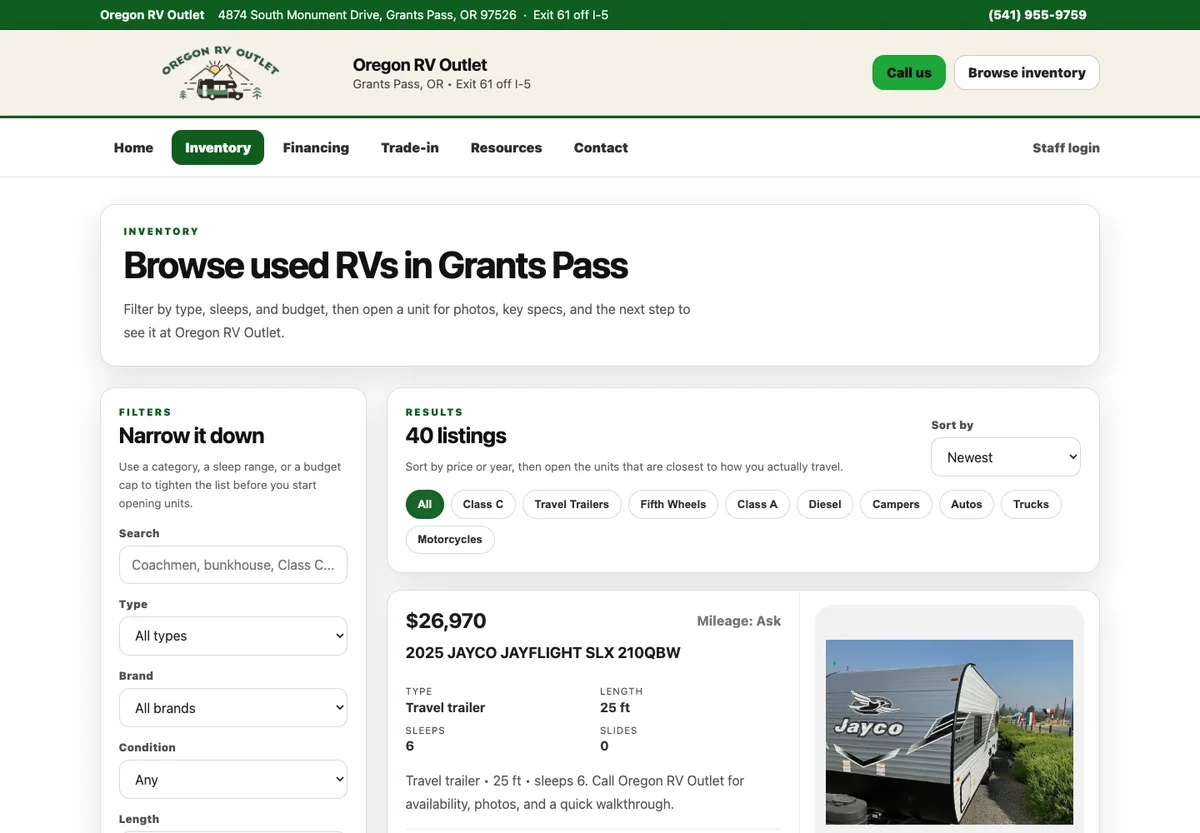

I run Good Creations in Grants Pass. I work directly with business owners on website design, content, and search. My work includes service writing, inventory websites, and custom publishing tools.
Meet Bob