- Evaluating the effectiveness of your website.
- A basic understanding of Google’s search algorithm, and how it might apply to your SEO efforts.
- How to use social media and content marketing to generate interest.
To keep the examples concrete, I’m using a chiropractor all the way through. The same principles apply to any business.
1. Evaluating the Effectiveness of Your Website
Your website is the center of your digital marketing. It guides visitors through a sales process and starts a connection with people who could become your clients. Its most important job is turning visitors into customers, and to do that it has to show them why your business is the one to choose.
When someone new visits your website, what’s the most important thing they should know about your business? What do you want them to see and read first?
Once you know what you want to say, the next step is deciding how to say it: the colors, the photos and the headlines that carry your message. That leads to the most important question of all:
What do we want them to do next?
If someone visits your website and takes no action, it’s like a customer who walks into your office, looks around, and walks straight back out.
That is called a bounce. You lose the chance to turn that visitor into a client, and Google notices when searchers leave a page right away. I explain how Google uses that information in the Basics of Google section below.
For now, let’s go back to the question, “What do we want them to do next?” The answer depends on the end goal of your website. For a chiropractor it’s simple: you want the visitor to book an appointment online or pick up the phone and call. So what would it take to get them there?
The best way to evaluate your website is to look at it through the eyes of your ideal client. Keep in mind that you only have their attention for a few seconds.
Above the fold
This is an old term from the newspaper business. Big papers like the LA Times and the Washington Post were folded in half on the newsstand, and the half you could see before picking one up was “above the fold.”
On your website, the fold is the point where someone has to scroll. The space above it is your most valuable digital real estate, and it should carry your strongest message. Everything below the fold supports it.
Emotional Connection
Every major purchase you have ever made was an emotional decision. You may have used logic to justify it, but when the price fit your budget you chose the option you felt connected to. To hold someone’s attention in those first few seconds, your website has to make that connection.
The colors, fonts, spacing, images and headlines all work together to tell the story of your business. You may not think so right now, but every business has a story to tell. Online, how well you tell that story is what makes people choose you.
Once your website turns visitors into customers, Search Engine Optimization is the next piece of your digital marketing plan.
2. The Basics of Google
To understand what Google looks for in a website, it helps to know how online search started. Before Google, you found things by scrolling through alphabetical directories. Looking for a chiropractor online was like flipping through the Yellow Pages, with AAA Chiropractic listed first, closely followed by AAAA Chiropractic!
Then Google came along and changed the online world. People knew what they were looking for, but not who. They wanted the internet to do the work and show them the best chiropractor in the area.
How could a computer program know that one website was better than another? Google decided to let the internet tell it. Its algorithm counted how many other websites linked to yours. If people were willing to link to your website, the thinking went, it was probably better than one nobody linked to.
As Google grew, SEO companies figured out the formula and started selling backlinks to businesses. That changed in 2011, when the New York Times investigated J.C. Penney, which had ranked number one on Google for almost every search term during the previous holiday season. The Times found thousands of artificial backlinks and asked Google for comment. Google’s “comment” was to drop J.C. Penney’s pages far down the results, and then it went to work rewriting its algorithm. Google has made hundreds of updates since then, some of them major rewrites.
Artificial Intelligence
Google has also been at the front of AI research. In 2022 its AI had become so sophisticated that one of its engineers claimed their chatbot was sentient. Google still wants the internet to tell it which sites are best, and it uses AI to find patterns in anonymized data and match people with the websites that suit them.
When you are signed in to Google, the results you see are personalized to you. If you click a link from a search, Google pays attention to what happens next. If you bounce straight back, you have told Google that page wasn’t what you were looking for. If you stay, read, and share the site with others, Google takes note of that too.
Every change Google makes to its algorithm is meant to match people with the right websites. As web designers, our job is to help you identify your target audience and build a site they will love. A website designed around your ideal clients benefits from every one of those updates.
So how does Google match websites and searchers? Here are a few of the things it looks at.
Bounce Rate
Your bounce rate (explained above) is one of the clearest signs of whether visitors found what they expected. If someone clicks your site in the search results, closes it, and clicks the next result, Google learns your page wasn’t the right match for that search.
Amount of Quality Content
Google’s original guidelines for building a Google-friendly website put it this way:
“Provide high-quality content on your pages, especially your homepage. This is the single most important thing to do. If your pages contain useful information, their content will attract many visitors and entice webmasters to link to your site. In creating a helpful, information-rich site, write pages that clearly and accurately describe your topic. Think about the words users would type to find your pages and include those words on your site.” https://support.google.com/webmasters/answer/40349?hl=en
For more information on how to create quality content, see our 7 tips for Creating Engaging Content article.
Social Media Activity
I cover social media in more detail below. When content you create becomes popular on social media, people link to it and share it, and those links help your rankings.
Mobile Friendliness
Google uses mobile-first indexing, which means it looks at the mobile version of your website first. Most people now search on their phones, and Google wants them to land on pages that work well there.
A website built for phones is easy to read and navigate on a small screen, so visitors stay longer and your pages have a better chance of ranking well.
Building the right website for your target audience includes making sure it works beautifully on every device they use.
Mobile Speed
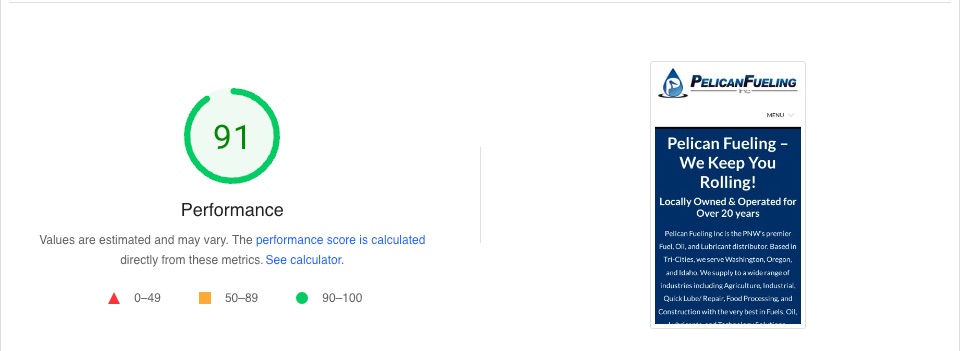
Page speed is a big part of the user experience, and Google pays close attention to how fast your site loads on a phone. One of our clients saw their rankings drop when Google switched to mobile-first indexing. We improved the speed of their website, and within a week they were ranking in the top three for several competitive keywords. Aim for a score in the high 80s or better on Google’s Speed Test page.
Most of The Black Bird’s Visitors Come From Search
The Black Bird’s department pages, weekly sales and event pages give local shoppers something to find on Google every week of the year.
Google Search Console and Analytics via Site Kit, August 19 to September 15, 2026; rounded dashboard values. Site-wide activity, not sales.
Departments people search for
Anglers searching for gear in Medford land on the fishing department, with the current promotions right there.
See The Black Bird project →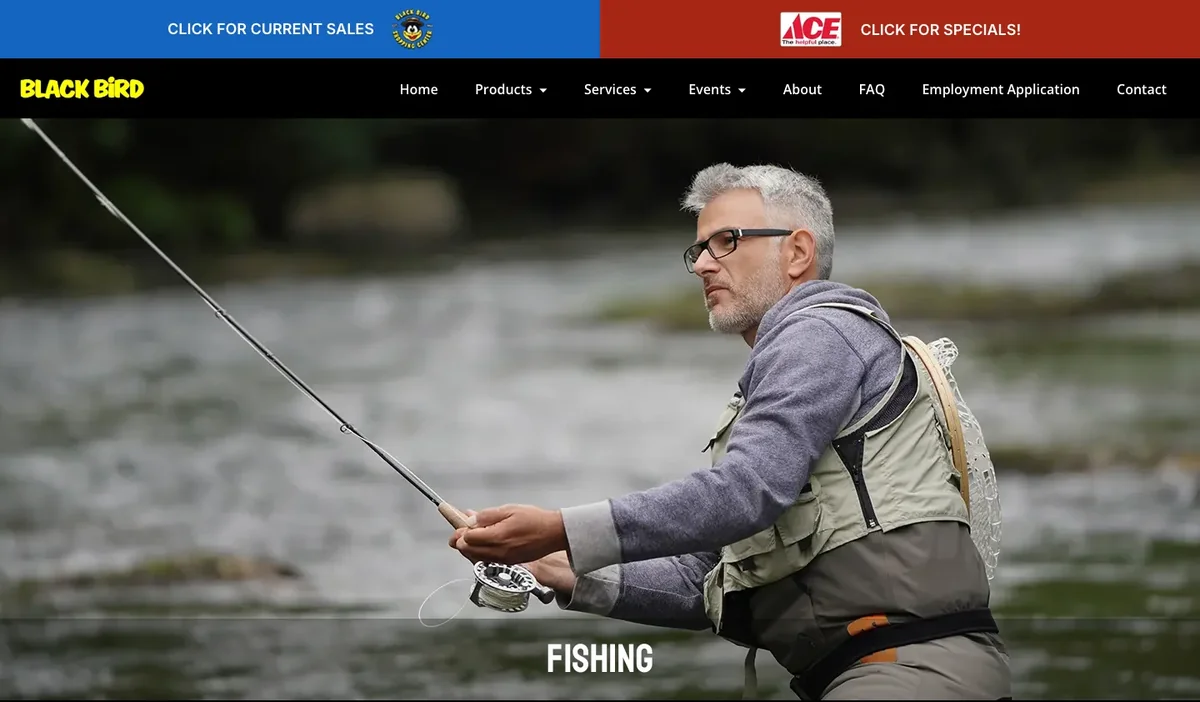
3. The Basics of Social Media
Social media can help your search rankings, and it also builds a following and puts your business in front of more people. Every person who connects with you on social media can share your business with their whole social circle.
Choose the Right Platform
Focus on the platforms your target audience uses most. If you sell to other businesses and professionals, LinkedIn is an excellent place to start. A chiropractor may find more patients on Facebook and Instagram.
Develop a Content Strategy
A content strategy decides what you will create and how often you will post it. That can include blog posts, social media updates, videos and podcasts, whatever reaches your audience best.
Engage With Your Audience
Social media lets you have a two-way conversation. You share updates with your followers, and they reply with questions, comments and feedback. Answering them builds a loyal community of people who feel connected to your business.
To engage your audience on social media:
- Answer comments and messages. When someone takes the time to comment or send a message, reply promptly and helpfully. Your followers see that you listen.
- Ask for feedback. Ask your followers questions and invite them to share their experiences. Their answers often give you ideas for new services and your next posts.
- Share your followers’ posts. Reposting something a patient or customer created thanks them for their support and introduces them to your audience.
- Host a Q&A or a live stream. A chiropractor could answer back-pain questions live for half an hour, in real time.
Engaging with your audience builds stronger relationships and a sense of community around your business.
Analyze and Adjust
Social media analytics show you which posts people respond to. Engagement, clicks and website visits tell you what to make more of and what to change.
To analyze and adjust your content strategy:
- Track your numbers. Each platform has built-in analytics. Look at likes, comments, shares and clicks to see which posts get the most attention.
- Try a third-party tool. Tools that gather all your accounts in one place give you more detail and let you compare your results with your competitors.
- Look for patterns. Which kinds of posts do well, and which get little response?
- Adjust. Change the type of content you create, how often you post, or how you promote it, based on what the numbers show.
Reviewing and adjusting regularly keeps your content focused on what your audience wants and on your goals.
Be Consistent
Content marketing works best on a schedule you can keep. A chiropractor could post stretching and exercise tips every Thursday to get followers ready for the weekend. Keep your brand voice and message the same across every post, so your audience recognizes you and keeps coming back.
The goal of social media in content marketing is to build relationships with your audience and bring them to your website.
How We Can Help
We can:
- Evaluate your website and let you know where it can be tweaked or improved.
- Create a marketing strategy for your business, including blogging, social media and email marketing.
- Help you implement your online marketing strategy or train you on how to do it yourself.
- Help you write your blog articles and create social media posts.
If you would like a quote for your project, call or text me at (541) 226-8087 or send the details through our contact page.
Get StartedOregon RV Outlet Turned Its Inventory Into Search Traffic
Every RV on Oregon RV Outlet’s lot has its own page with photos, specifications and a way to call or text about that unit. Those pages give Google something specific to show for each search a shopper makes.
August 13 to September 9, 2026. Clicks and impressions from Google Search Console; organic-search sessions from Google Analytics. These are different measures and are not added together.
One page for every unit on the lot
A shopper searching for a specific trailer can land on the page for that exact trailer, see the photos, and call about it.
See the Oregon RV Outlet project →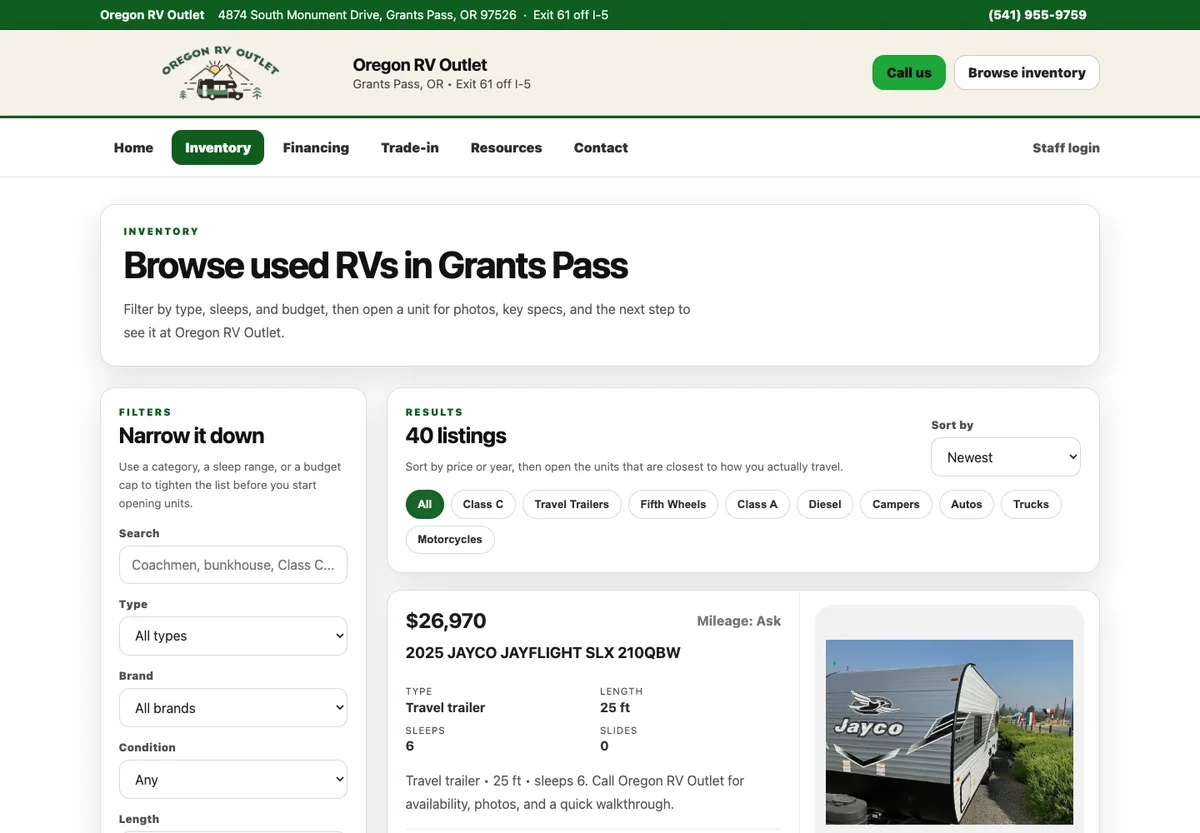

I run Good Creations in Grants Pass. I work directly with business owners on website design, content, and search. My work includes service writing, inventory websites, and custom publishing tools.
Meet Bob